Avatar as a Rorschach Test
On the cab ride back from the theater where we saw Avatar, my friend Uthra remarked how it was odd that protagonist Jake Sully's avatar in the movie appeared with a U-shaped marking on his forehead which very closely resembled the naamam of the Indian Vaishnavite Brahmin 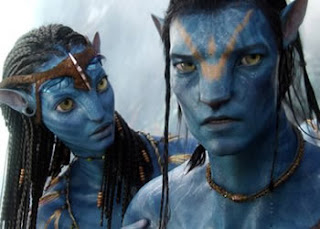 subcaste. She also remarked that the blue colouring of Na'vi, the alien race to which Jake's avatar and many other characters belong was similar to Ram and Krishna, two of the avatars of Vishnu. Clearly, she said, the Na'vi were Vaishnavites.
Of course, we just had to stretch the metaphor further. The very concept of Avatars is Vaishnavite in origin. Also, the Na'vi are worshipers of Eywa, a force that maintains the balance of life on their world. This is also the prime motivation of Vishnu. The Na'vis' human antagonists, on the other hand, wish to destroy much of their world to extract resources for their own civilisation - a motivation that can broadly be described as Shaivite. The main human villain, Colonel Quaritch, ever has three horizontal slashes on his head that resemble the tilak that Indian Shaivite Brahmins wear on their foreheads. Clearly, by our reasoning, Avatar is Vaishnavite propaganda aimed at showing Shaivites in a negative light and positing a victory for the Vaishnavites in the future struggle between the two (this is obviously nonsense - Shaivites are the the Vaishnavites' superior in everything that matters).
But when I came back home and read the multitude of reviews of Avatar, I realised that almost everyone else that saw the movie had been engaging in similar allegory. Some praised it as a metaphor for the displacement and genocide of the Native Americans. Others hailed it as a commentary on the unjust seizure of private property by corrupt local governments using eminent domain. Ross Douthat of the New York Times eviscerated it as an advertisement for taking up pantheism in preference to the Western world's more prevalent Abrahamic religions. Annalee Newitz of io9 decried it as an escapist fantasy seeking to assuage white guilt while maintaining white privilege. Other people looked through their 3D glasses and saw variously notions of the white man's burden, the noble savage, blame-America-first liberals, Iraq War criticism, the military-industrial complex, gorilla researchers in the Congo and many other things besides. And they either loved or hated the movie for these reasons.
Make no mistake, Avatar is a path breaking movie. It is perhaps even a historical movie - the first to utilise technologies such as performance capture, the first to depict CGI characters in primary roles without entering the uncanny valley, the first to use 3D in a non-gimmicky fashion in a mainstream film. It is visually appealing and an incredible experience to watch and listen to. But in spite of all this, Avatar serves as a kind of Rorschach test to project our hopes and fears into. We either love or hate Avatar based on not what it is, but on the deeper meaning we read into it. It becomes to us either a needed confirmation of cherished views, or an unwelcome statement of positions we despise and we develop strong feelings based on these readings of the movies.
So what I am basically saying is that Avatar is the cinematic equivalent of Barack Obama. Stay tuned for the inevitable Nobel Prize next year.
 subcaste. She also remarked that the blue colouring of Na'vi, the alien race to which Jake's avatar and many other characters belong was similar to Ram and Krishna, two of the avatars of Vishnu. Clearly, she said, the Na'vi were Vaishnavites.
Of course, we just had to stretch the metaphor further. The very concept of Avatars is Vaishnavite in origin. Also, the Na'vi are worshipers of Eywa, a force that maintains the balance of life on their world. This is also the prime motivation of Vishnu. The Na'vis' human antagonists, on the other hand, wish to destroy much of their world to extract resources for their own civilisation - a motivation that can broadly be described as Shaivite. The main human villain, Colonel Quaritch, ever has three horizontal slashes on his head that resemble the tilak that Indian Shaivite Brahmins wear on their foreheads. Clearly, by our reasoning, Avatar is Vaishnavite propaganda aimed at showing Shaivites in a negative light and positing a victory for the Vaishnavites in the future struggle between the two (this is obviously nonsense - Shaivites are the the Vaishnavites' superior in everything that matters).
But when I came back home and read the multitude of reviews of Avatar, I realised that almost everyone else that saw the movie had been engaging in similar allegory. Some praised it as a metaphor for the displacement and genocide of the Native Americans. Others hailed it as a commentary on the unjust seizure of private property by corrupt local governments using eminent domain. Ross Douthat of the New York Times eviscerated it as an advertisement for taking up pantheism in preference to the Western world's more prevalent Abrahamic religions. Annalee Newitz of io9 decried it as an escapist fantasy seeking to assuage white guilt while maintaining white privilege. Other people looked through their 3D glasses and saw variously notions of the white man's burden, the noble savage, blame-America-first liberals, Iraq War criticism, the military-industrial complex, gorilla researchers in the Congo and many other things besides. And they either loved or hated the movie for these reasons.
Make no mistake, Avatar is a path breaking movie. It is perhaps even a historical movie - the first to utilise technologies such as performance capture, the first to depict CGI characters in primary roles without entering the uncanny valley, the first to use 3D in a non-gimmicky fashion in a mainstream film. It is visually appealing and an incredible experience to watch and listen to. But in spite of all this, Avatar serves as a kind of Rorschach test to project our hopes and fears into. We either love or hate Avatar based on not what it is, but on the deeper meaning we read into it. It becomes to us either a needed confirmation of cherished views, or an unwelcome statement of positions we despise and we develop strong feelings based on these readings of the movies.
So what I am basically saying is that Avatar is the cinematic equivalent of Barack Obama. Stay tuned for the inevitable Nobel Prize next year.
Labels: Comparitive Pop-Culture, DesiPundit, Movies
posted by Kunal at 12:37 AM
10 comments

 |
|


